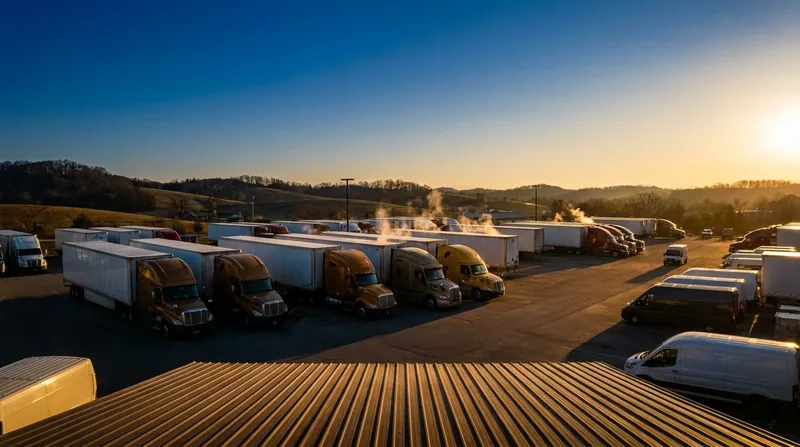
How to Start a Trucking Company in Maryland: USDOT, IRP and Port of Baltimore Drayage
How to Start a Trucking Company in Maryland: USDOT, IRP, and Port of Baltimore Drayage
Maryland's strategic location on the East Coast, proximity to the Port of Baltimore, and position on major freight corridors make it a natural hub for trucking operations. But before you buy your first truck, you need to navigate federal motor carrier rules, state-level licensing, interstate registration, and insurance requirements. This guide walks you through the exact steps, costs, and timelines.
What You Need Before You Start: Business Formation and Basics
You can operate as a sole proprietor, but most trucking operators form a business entity with the Maryland State Department of Assessments and Taxation (SDAT) for liability protection.
Choose Your Business Structure
Most trucking operators choose between an LLC (Limited Liability Company) or a Corporation. Here are the essentials:
- LLC (Limited Liability Company): Most trucking companies in Maryland choose this structure for simplicity and tax flexibility. Filing fee is $100. Your annual report is due April 15 each year and costs $300. The document you file is called Articles of Organization. Your company name must include "Limited Liability Company," "L.L.C.," "LLC," "L.C.," or "L C" and cannot be misleadingly similar to existing Maryland entities.
- Corporation: A formal corporate structure offers similar liability protection. Filing fee is $120. Like an LLC, you owe the $300 annual report fee every April 15. You file Articles of Incorporation.
An LLC is a pass-through entity, so its owners report business income on personal Maryland tax returns, subject to Maryland's graduated state rate of 2% to 6.5% plus county income tax of 2.25% to 3.30% (2026 rates). Consult a Maryland CPA or tax attorney about S-corp election if you will have significant profit.
File Your Business Entity
File through Maryland Business Express, the state's online filing portal: https://egov.maryland.gov/businessexpress
Standard processing takes about 60 days (the second full calendar month after submission). If you need it faster:
- Expedited review (7 to 14 business days): add $50
- Online rush (3 hours if submitted by 2:30 p.m. on a business day): add $325
- Same-day paper drop box: add $425
You will need to name a resident agent, a Maryland citizen over 18, a Maryland corporation, or a Maryland LLC with a street address in Maryland (no P.O. box). The agent must consent to the role before you file. Changing the agent later costs $25 per entity.
Step 1: Obtain Your USDOT Number (Federal)
The U.S. Department of Transportation issues USDOT numbers to motor carriers. This is a federal requirement, not a Maryland one, but it is your starting point.
Who Needs a USDOT Number
You need a USDOT number if you:
- Operate a commercial vehicle with a gross vehicle weight rating (GVWR) of 10,001 pounds or more, OR
- Operate any vehicle in interstate commerce (crossing state lines) that carries hazmat, OR
- Operate for-hire or as a contract carrier (carrying freight for compensation)
If you are operating purely intrastate (within Maryland only) in non-hazmat freight and not for hire, confirm what applies with the MVA and the Maryland Department of Transportation. See the Maryland-specific section below.
How to Apply
Apply online at the Federal Motor Carrier Safety Administration (FMCSA) portal: https://www.fmcsa.dot.gov/registration
You will need:
- Your business EIN (Employer Identification Number) from the IRS. Apply at https://www.irs.gov/ein if you do not have one. This is free and can be done online.
- Your Maryland business registration confirmation (issued when you file with SDAT).
- Details on the number and type of vehicles you will operate.
- Your business address and a primary contact name and phone number.
There is no application fee for a USDOT number. Confirm current processing times with FMCSA. Once approved, you receive a USDOT number (a unique nine-digit identifier) that you must display on all your trucks and business documents.
Step 2: Apply for MC Operating Authority (Federal)
If you are a for-hire carrier or a contract carrier (operating for compensation), you need Motor Carrier (MC) Authority from the FMCSA. If you are a private carrier (operating only for your own company), you do not need MC authority.
What MC Authority Covers
MC authority is granted by carrier type. Common categories include:
- Common carrier: Hauls freight for the general public for pay.
- Hazardous materials: Requires additional training, endorsements and higher insurance minimums. Add this only if you plan to haul hazmat.
- Household goods: Movers have additional requirements, and Maryland household goods movers register with the Maryland Department of Labor.
- Contract carrier: Hauls freight under contract for specific customers.
How to Apply
File Form OP-1 (Application for Motor Carrier Property Authority) with the FMCSA. You can do this through the same FMCSA registration portal.
You will need:
- Your USDOT number (from Step 1).
- Proof of financial responsibility: insurance that meets the federal minimum for your cargo ($750,000 for most for-hire general freight in vehicles over 10,001 pounds; higher for hazmat). See the insurance section below.
- Safety statements and certifications.
- A list of all vehicles you will operate (or you can add them later).
Processing time for MC authority is typically 30 to 60 days. The FMCSA application fee is $300 per authority. Confirm the current fee with FMCSA.
Step 3: Secure Motor Carrier Insurance
Before you operate a single mile, you must have commercial motor carrier liability insurance. The federal minimum for most for-hire general freight in vehicles over 10,001 pounds is $750,000, and hazmat and passenger carriers face higher minimums. Cargo insurance and physical damage coverage are not mandatory by law but are strongly recommended and often required by customers or brokers.
Insurance Requirements
- Liability coverage: Federal minimum of $750,000 for most for-hire general freight (higher for hazmat). This covers bodily injury and property damage claims from third parties.
- Insurance filings (MCS-90 endorsement and BMC-91 or BMC-91X): Your insurer provides the MCS-90 endorsement and files the BMC-91 or BMC-91X with the FMCSA, and your authority depends on keeping it current.
- Cargo insurance (optional but common): Covers freight you are carrying. Cost varies by commodity. For Port of Baltimore drayage, expect to pay more for high-value electronics or refrigerated goods.
- Physical damage (optional): Covers your trucks in case of accident, theft, or collision.
Liability premiums for a new trucking company vary widely with the operation, equipment and driving record, and typically run well above what new owners expect. Get quotes from three to five brokers before you budget.
Step 4: Maryland Intrastate Rules (State Level)
Maryland regulates intrastate motor carriers separately from federal USDOT rules. However, Maryland's specific requirements for intrastate for-hire trucking (whether you need a state motor carrier license, how to apply, and the associated fee) are not publicly documented in a single accessible location.
You must confirm the following with the Maryland Motor Vehicle Administration (MVA) and the Maryland Department of Transportation (MDOT):
- Do you need a state motor carrier license or permit if you are operating intrastate only?
- What is the application process and fee?
- Are there intrastate insurance requirements that differ from federal minimums?
- What are the vehicle inspection and maintenance standards for intrastate operations?
Contact the MVA at https://mva.maryland.gov or 1-410-768-7000. Ask specifically about commercial motor carrier permits or intrastate operating authority.
Step 5: IRP (International Registration Plan) Apportioned Registration
If you will operate in multiple states (or plan to in the future), you need IRP apportioned registration. Maryland is a member of the IRP, a reciprocal registration agreement among U.S. states and Canadian provinces.
What IRP Covers
Instead of registering your vehicle in every state you drive through, you register it in your base state (Maryland, in this case) and receive a decal valid in all IRP member jurisdictions. You pay registration fees proportional to the miles you estimate you will drive in each state.
How to Register
Apply through Maryland MVA. You will need:
- Your USDOT number.
- MC operating authority (if applicable).
- Vehicle identification number (VIN) for each truck.
- Estimated annual mileage in each state (this determines your apportioned fees).
- Proof of ownership or a current title for each vehicle.
IRP fees depend on weight class, estimated mileage, and the mix of states, so ask the MVA for a fee estimate. Renewal is annual, usually in the month of your base state registration.
For intrastate-only operations (not crossing state lines), you will register your trucks under Maryland's standard commercial plate system through the MVA instead.
Step 6: Vehicle Inspections and Compliance
Every truck must pass commercial vehicle inspection before it goes into service. You will also need to maintain records of all inspections, maintenance, and repairs. Inspections are conducted by certified inspectors; contact the MVA for a list of authorized inspection stations in Maryland.
You must keep:
- Vehicle maintenance and repair records.
- Driver logs (now mostly electronic via ELDs, Electronic Logging Devices).
- Inspection reports.
- Insurance certificates.
- USDOT and MC operating authority documentation.
Port of Baltimore Drayage: A Key Opportunity
The Port of Baltimore is a major engine for trucking in Maryland. In 2025, the port handled a record 2,223 cargo vessel calls and moved 1,113,309 TEUs (twenty-foot equivalent containers) at Seagirt Marine Terminal. Drayage operations, short-haul trucking between the port and nearby distribution centers, rail yards, or warehouses, are the lifeblood of port logistics.
Why Port Drayage Matters
If you are starting a trucking company in Baltimore or Northern Maryland, port drayage is a natural niche. Cargo volumes are high, rates are competitive, and the distance from port to warehouse is typically short (15 to 50 miles), making it profitable even with thin margins.
Port Drayage Requirements
In addition to standard MC authority and insurance, many port drayage operators need:
- Port-specific authorization: Some ports (including Baltimore) require drayage carriers to register with the port or a port authority before picking up or dropping off containers. Confirm this with the Maryland Port Administration.
- Chassis and equipment: Most drayage work requires chassis (the framework that holds a container). You can own chassis outright, lease them from equipment providers, or use shared equipment pools operated by the port terminal or logistics companies.
- Hazmat certification (if applicable): If you haul hazardous materials from the port, you need hazmat endorsement on your driver's commercial license (CDL) and additional DOT training.
- Real-time tracking systems: Many customers and port operators require GPS tracking of shipments. Ask providers for telematics pricing.
Port Growth Context
The Port of Baltimore is undergoing significant infrastructure investment. The CSX Howard Street Tunnel project was expected to complete in 2026 and add approximately 160,000 containers per year to port throughput; however, confirm its current status with the Maryland Transportation Authority. The Francis Scott Key Bridge rebuild (damaged in March 2024) has a projected completion in late 2030 at an estimated cost of $4.3 to $5.2 billion, though these timelines and costs have been subject to revision. Confirm current estimates with the Maryland Transportation Authority.
Timeline and Estimated Costs
Here is what you can expect from start to first truck on the road:
| Step | Time | Cost |
|---|---|---|
| LLC or Corporation formation (Maryland) | 7 to 14 days (expedited) or 60 days (standard) | $100 to $325 (filing plus expedited fee) |
| USDOT number application | Confirm with FMCSA | Free |
| MC authority application | 30 to 60 days | $300 per authority (application fee) |
| Motor carrier insurance (1 truck, 1 year) | 1 to 3 days | Varies, get quotes |
| IRP registration (1 truck, 1 year) | 5 to 10 business days | Varies by weight and mileage |
| Vehicle inspection and compliance | 1 to 2 days | Varies |
Total startup cost estimate (first truck, first year): depends mostly on insurance quotes, so build your budget from real quotes. It does not include the truck itself, driver salary, fuel, or maintenance.
Total timeline to operation: 60 to 90 days if you use expedited filings. Standard timeline is 90 to 120 days.
Common Mistakes to Avoid
- Operating without USDOT or MC authority: Operating without required federal registrations can bring fines and put vehicles out of service. Do not skip this step.
- Underestimating insurance costs: Many new operators underestimate insurance costs. Get quotes early.
- Assuming state and federal requirements are the same: Maryland intrastate rules may differ from federal FMCSA rules. Confirm with both the MVA and FMCSA.
- Forgetting to renew annually: Your MC authority, IRP registration, and insurance all renew on different schedules. Missing even one renewal can sideline your business and trigger penalties.
- Mixing personal and business accounting: Keep business and personal finances completely separate. This protects your LLC liability shield and simplifies tax time.
- Overlooking driver compliance: Every driver needs a valid commercial driver's license (CDL) and a DOT medical certificate. Hiring an unqualified driver creates liability for you.
Final Steps and Resources
Once you have USDOT and MC authority in hand and your insurance confirmed, you are ready to buy or lease trucks and bring on your first driver. But do not stop there. Set up:
- A dedicated business bank account (never use personal accounts for business expenses).
- Payroll processing for drivers and any administrative staff.
- A logbook system or ELD (Electronic Logging Device) to comply with hours-of-service rules.
- A customer relationship system to track freight and billing.
- Fuel and maintenance budget; build fuel and maintenance costs into your pricing from real quotes.
Key Resources
- Federal Motor Carrier Safety Administration (FMCSA): https://www.fmcsa.dot.gov, USDOT numbers, MC authority, safety regulations.
- Maryland Motor Vehicle Administration (MVA): https://mva.maryland.gov, Maryland-specific requirements, IRP registration, vehicle inspection.
- Maryland Department of Transportation (MDOT): https://mdot.maryland.gov, Port information, infrastructure projects.
- Maryland State Department of Assessments and Taxation (SDAT): https://dat.maryland.gov/businesses/Pages/default.aspx, Business formation and entity registration.
- Maryland Port Administration: Contact through MDOT for port-specific drayage and carrier requirements.
- Small Business Development Center (SBDC): https://www.marylandsbdc.org, Free business planning advice.
Legal and Tax Disclaimer
This article is informational only and does not constitute legal or tax advice. Trucking regulations are complex and vary by commodity, vehicle weight, operating region, and business model. Before you start operations, consult a Maryland-based attorney who specializes in motor carrier law and a certified public accountant (CPA) familiar with transportation businesses. Requirements and fees are subject to change; verify all figures with the applicable state and federal agencies before committing funds.
Starting a trucking company in Maryland requires navigating federal USDOT and MC authority, state-level licensing and registration, insurance compliance, and port-specific rules if you serve Baltimore. Timelines and costs vary, so build your budget from real quotes before you buy your first truck. But with clear planning, accurate paperwork, and a solid understanding of the rules, you can launch a compliant, profitable operation ready to serve Maryland's freight market and the Port of Baltimore's booming drayage sector.
Keep exploring: related Maryland guides
- How to Start a Towing Business in Maryland
- How to Start a Courier and Delivery Business in Maryland
- How to Start a Moving Company in Maryland
- How to Start an LLC in Maryland
- Maryland Business License
- How Much Does It Cost to Start a Business in Maryland
- All Maryland business types
- Every Maryland guide in one place